Now that you’ve travelled through the history of the South African currency with us, we’d like to take you on a coin making journey next, starting with how coins are designed.

Coins say a lot about a country because they celebrate its people, heritage, nature and culture. Go ahead, pull a coin out of your pocket and take a good long look at it. What do you see on it? Have you ever noticed the detail on it before? Read on to see how the design moves from concept to coin…

The South African Mint employs skilled artists, engravers and knowledgeable technicians to develop coins, and ensure efficient manufacturing down to the most finite detail.

 
COIN DESIGN

The coin designing process starts with numerous concept designs which explore the visual representation of the theme through different compositions of the chosen elements. Once this is done. The Mint’s artists either create digital 3D models and renders, or manipulate photographs or digital illustrations, or create artwork using pencil, charcoal or water colour, in accordance to their preferences, to create a detailed design.

The completed coin design then goes through a rigorous signing-off process which includes the following bodies, in this order:

  • The South African Mint Board
  • The Governors’ Executive Council of the South African Reserve Bank
  • The Cabinet of the Republic of South Africa and
  • The Minister of Finance
  • The approved design is then published in the Government Gazette
Vincent Chipa.jpg
Senior Designer/ Artist at the South African Mint, Lilian Guerra, says designing a coin requires you to reference the past while attempting to create a design which informs on the time and place we live in today. She says this opens up a wonderful opportunity to explore and discover the different perspectives of a country’s history, the cultural heritage of its people and their stories and the natural or constructed world they live in, and it offers endless possibilities to better understand the world we live in.
RELIEF MODEL

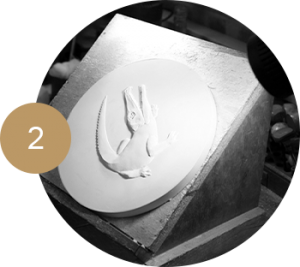
Once the coin design is approved and gazetted, an engraver recreates the coin design using modelling clay applied to a glass plate, to make a three-dimensional model of it.

This scrupulous and technical task takes about three weeks to complete, and requires highly-specialised skills as this model must contain as much detail as possible.

This sculptural process has been used for decades at the South African Mint and remains the preferred method of creating relief models.However, as digital sculpting software develops, digital tools are increasingly used to compliment and in some cases replace the hand modelling process.

Vincent Chipa.jpg
South African Mint’s Senior Die-Sinker & Engraver, Vincent Chipa, says the most exciting feeling is when he gets a new coin design to model as he always imagines what the actual coin will look like. The first coin he ever modelled was the common obverse of the Protea – Life of a Legend series, which features Nelson Mandela in his designer shirt, with protea flowers below his bust. This is his favourite coin as he could feel the spirit of Madiba with him while modelling the design.

 
4_21
DIGITAL SCULPTING

A plaster version of the model is then transferred onto a computer using a high-resolution scanner, which maps the contours of the model section by section, using extremely sensitive technology. Once the model is scanned, the engraver can remove imperfections and add finishing touches to the digitised plaster model.

At this stage the typographic elements are added to the model as is the landing of the coin-. The finished digital model of the coin represents what the coin will look like once it is minted, and it is reviewed to make sure it can be physically produced on the Mint’s coining presses.

MACHINE PUNCH

Once the coin model is completed, a computer-controlled machine cuts the model directly into a piece of high-grade steel and creates what is known as the machine punch. An engraver sands and polishes the engraved steel and it is then used to strike a matrix.

 
51
MATRIX

The machine punch is struck onto a block of steel to create a negative impression of the model, called a matrix. The image on the matrix is always a negative or sunken image. This is then used to strike the master. It is safely stored away as an archival reference and for reproduction of masters for that coin.

MASTER PUNCH

The matrix is struck onto a block of steel, similar to the previous step, to create a positive embossing of the design, known as a master punch. The image on the master punch is always a positive or raised image. The master punch is then used to strike the production dies that will be used to mint coins.

 
8_21
PRODUCTION DIES

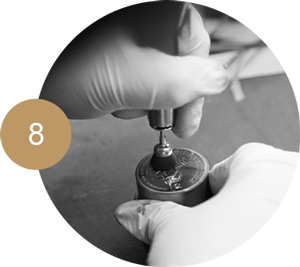
Coin dies can be considered as stamps which will be used to imprint the designs onto the coin blank. The die is struck from the master punch, and the image on the die is always a negative or sunken image. This way, when the coins are struck, the final product has positive or raised details.

FINISHING ON THE PRODUCTION DIES

Various finishes can be applied to the production dies, depending on the use of the coins produced. Circulation coins have a uniform surface finish applied to both the reverse and the obverse dies. On collectable coins the application of various finishes has become a part of the creative process of designing a coin. Laser engraving machines are used to create a variety of finishes which can be selectively and accurately applied to create a range of shades or textures on different elements within a design.

THE FINAL PRODUCT

Earlier during the die preparation process, before most of the working dies are created, test strikes are conducted to minimise manufacturing and final product problems. The final production dies are now ready for the production process.

Senior Engraver & Die-Sinker at the South African Mint, Paul Botes did the modelling, engraving and laser finishing on the 2017 R2 Heart Transplant coin, the coin that won the 2019 Coin of the Year – Best Contemporary Event Award and shared the thrill of being part of a team that can compete on the international arena. He says that people don’t know about his job is that the design work is software based and relief modelling is done both in clay and in software, so one needs artistic ability, good eyesight, fine motor skills and lots of patience in this work. One also needs machine knowledge to be able to programme and operate the various machines used in his field.
KIDS, DESIGN YOUR OWN COIN!

Being cooped up in the house due to the national lockdown and the harsh winter weather is probably not doing any good for the kids’ creativity. Keep their imagination alive and help them unleash their inner artist with our coin design activity!

Click here to download the kids’ coin design template.

WHAT HAPPENS AFTER THE COIN IS DESIGNED?

Now that we know how the coin design evolves and the production dies are ready – what happens next? Next month we will take you through the manufacturing process…